
Duval County Resident Eras
Choose a source by date and by the fact needed. Deeds name title parties; directories name selected occupants; census schedules describe enumerated households. Maps and permits explain the building around those people.
| Source | Years it covers | Where held | What it shows |
|---|---|---|---|
| Online Official Records | 1988 to present; marriages from February 1981 | Duval Clerk Acclaim | Grantor, grantee, instrument, date, book/page, image |
| Earlier Official Records | Before 1988 | Clerk staff and record books | Older title chain beyond the web index |
| Property roll | Current and displayed historical fields | Property Appraiser | Owner, mailing and site addresses, legal description, sales, year built |
| Federal census | Public schedules through 1950 | NARA, FamilySearch, JPL databases | Enumerated household at a date |
| City and reverse directories | Edition-dependent | JPL and licensed partners | Publisher-listed resident or occupant |
| Sanborn maps | Database range generally 1867 to 1970 | Jacksonville Public Library | Footprint, number, material, and use |
| Building permits | Portal coverage not officially stated | City Building Inspection | Work, dates, owner, applicant, and contractor |
For a recent home, start with the parcel and deed. For a mid-century address, add reverse directories and the 1950 census. For an older Jacksonville site, legal descriptions, deeds, maps, directories, and newspapers must carry the trail through address changes.
Start Duval County House History
The Property Appraiser is the modern anchor. Search the exact site address, then record the RE number, Primary Site Address, current owner, separate owner mailing address, legal description, subdivision or lot and block, year built, exemptions, sales, and Official Records book/page. The mailing address may belong outside Duval County. Homestead supports owner occupancy, but it does not list the household.
The legal description is more durable than a street number. It helps show that two deeds concern the same land even after renumbering, consolidation, or rebuilding. The year-built field dates an improvement, not the first human use of the land, and should be checked against permits and maps.
Walk Duval County Deeds Backward
The chain of title is the sequence of recorded transfers for the same land. Start with today’s parcel card and purchase deed. On a typical deed, the current owner is the grantee, meaning the recipient, and the prior owner is the grantor, meaning the transferring party. Match the legal description before moving back.
- Copy the current owner, RE number, legal description, and newest book/page from the parcel card.
- Open the purchase instrument in Duval Acclaim and confirm the grantee and land description.
- Take the grantor’s name and search that person or entity as an earlier grantee. Use a date range and spelling variants.
- Confirm the same lot, block, subdivision, or metes-and-bounds description, then repeat the process.
- At the 1988 web cutoff, preserve the party chain and citations and ask Clerk staff for the older index or deed book.
- Grantor
- The party transferring an interest in land.
- Grantee
- The party receiving that interest.
- Chain of title
- The linked sequence of transfers for the same parcel.
- Legal description
- The formal land description used to match records when a street address changes.
Do not treat every instrument as a sale. Quitclaim deeds and family transfers can show small consideration, and the Property Appraiser warns that documentary-stamp calculations may make a transfer appear to be a $100 sale.
Duval Records Beyond the Screen
The Clerk’s Official Records and Research service explains the 1988 online boundary, free self-printed uncertified records, copy routes, and certification options.
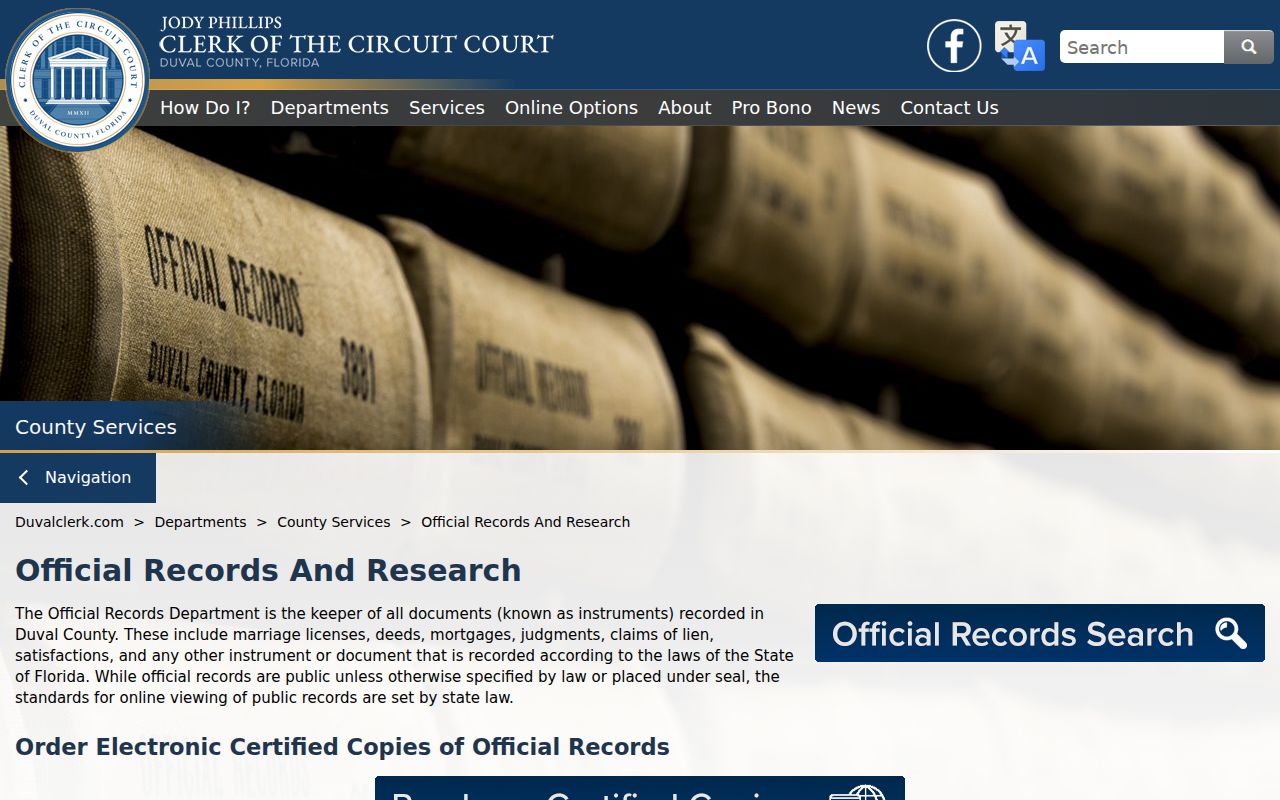
The page is the bridge when a search for previous residents reaches records not indexed online. Earlier work belongs with Official Records staff, not in a guessed gap.
Visit Room 1253 at the Duval County Courthouse, 501 W. Adams Street, Jacksonville, Monday through Friday from 8 a.m. to 5 p.m., or call 904-255-2025. A mail request goes to the same address with a self-addressed stamped envelope. Include parties, document type, date span, and known book/page. Office copies are $1 per page and certification is $2 per instrument plus copies. Credit-card payments carry the Clerk’s stated 3.5 percent service fee; mail payment cannot be a personal check.
Some lawfully accessible items do not appear online. Military discharges, death certificates, and files governed by Family, Juvenile, or Probate Rules faced web-publication limits after June 5, 2002. Ask about counter or request access while respecting confidentiality and redaction rules.
A Duval Deed Number Trap
Acclaim warns that instruments recorded from January 1 through January 20, 2004 once had an extra zero in their instrument numbers, which was later removed. An old citation may therefore fail as an exact lookup. Retry by grantor or grantee, or use book and page. Acclaim also advises trying every spelling variant.
This small index quirk carries a broad lesson: a missing web hit does not end a previous-residents search. Coverage, changed identifiers, spelling, protected images, and older paper books can all explain the gap.
Find Past Duval County Households
Owners are only one part of an address story. Jacksonville city directories are annual snapshots, while public federal census schedules capture a household once per decade. As of 2026, the 1950 census is the latest public population schedule under the 72-year rule. Later criss-cross editions reverse the usual name index and organize entries by street and house number.
- Choose the closest available directory edition and copy the entry exactly, including initials, spouse notation, occupation, and address.
- Check the adjacent edition before and after it. A gap may mean a move, death, missed canvass, spelling error, annexation, or renumbering.
- Pair a directory near 1940 or 1950 with the matching census household schedule and record each source’s date.
- Add the deed owner, but label that person separately from a directory occupant or census household member.
- Follow a disappearance through local newspapers, cemetery evidence, probate, and later directories rather than assuming why the person left.
The Duval County city directory page covers the collections and their entry conventions. Jacksonville Public Library has not published an exhaustive official year-by-year shelf list, so confirm each edition in the catalog or with Special Collections instead of inventing a continuous run.
Jacksonville’s Fire Break in Records
The Great Fire of 1901 destroyed much of downtown Jacksonville. Buildings, firms, and street evidence can shift sharply across that date even when the land description survives. A missing household after the fire does not by itself show a voluntary move. Compare deeds, post-fire directories, newspapers, plats, and Sanborn sheets.
Jacksonville Public Library’s Digital Sanborn Maps can reveal a building footprint, construction material, property number, and land use. A sheet does not name residents, but it can show that a later address refers to the same lot or that the building changed. Consolidation in 1968 creates a different break: most city and county functions merged, while Jacksonville Beach, Atlantic Beach, Neptune Beach, and Baldwin kept municipal governments.
That combination of fire, consolidation, and postal geography makes the legal description a vital thread. A Jacksonville mailing address alone cannot identify the right permit custodian or prove that two numbered addresses are the same place.
Date Duval County Building Changes
Permits can place construction, alteration, or inspection events between resident snapshots. Search by street number and name, parcel or RE number, permit number, contractor or applicant, type, status, and date range where the interface permits it. A result may show owner, site address, work, valuation, issue and final dates, and inspections.
A contractor or applicant is not necessarily a previous resident. Use the permit to date the building event, then use a directory, census, deed, or obituary for the person claim. When the portal is incomplete, ask the City department custodian for existing records by address and date span, or call 630-CITY at 904-630-2489. Ask for a cost estimate before a broad retrieval.
Close a Duval Resident Trail
An owner’s trail may end with an estate, personal representative, or heirs rather than a conventional sale. Search Duval probate dockets through CORE where public web access permits, and use courthouse or copy-request channels for older or web-restricted public files. A probate file can connect a decedent, representative, beneficiaries, and property, but access varies and confidential material stays protected.
Obituaries and newspapers can connect relatives, funeral homes, organizations, and former addresses. Jacksonville Public Library’s NewsBank access includes the Florida Times-Union from 1883, the Jacksonville Journal from 1901 through 1988, and the Beaches Leader from 1963. Access is available with a valid library card or at branches. Treat newspaper claims as leads and verify them in deeds, probate, vital records, or directories.
Cemetery and church records are decentralized. A burial register may show date, lot, section, and deed holder. The plot purchaser is not necessarily the person buried there.
Confirm Duval County Life Events
The Florida Bureau of Vital Statistics is physically located in Jacksonville, but proximity does not remove eligibility rules.
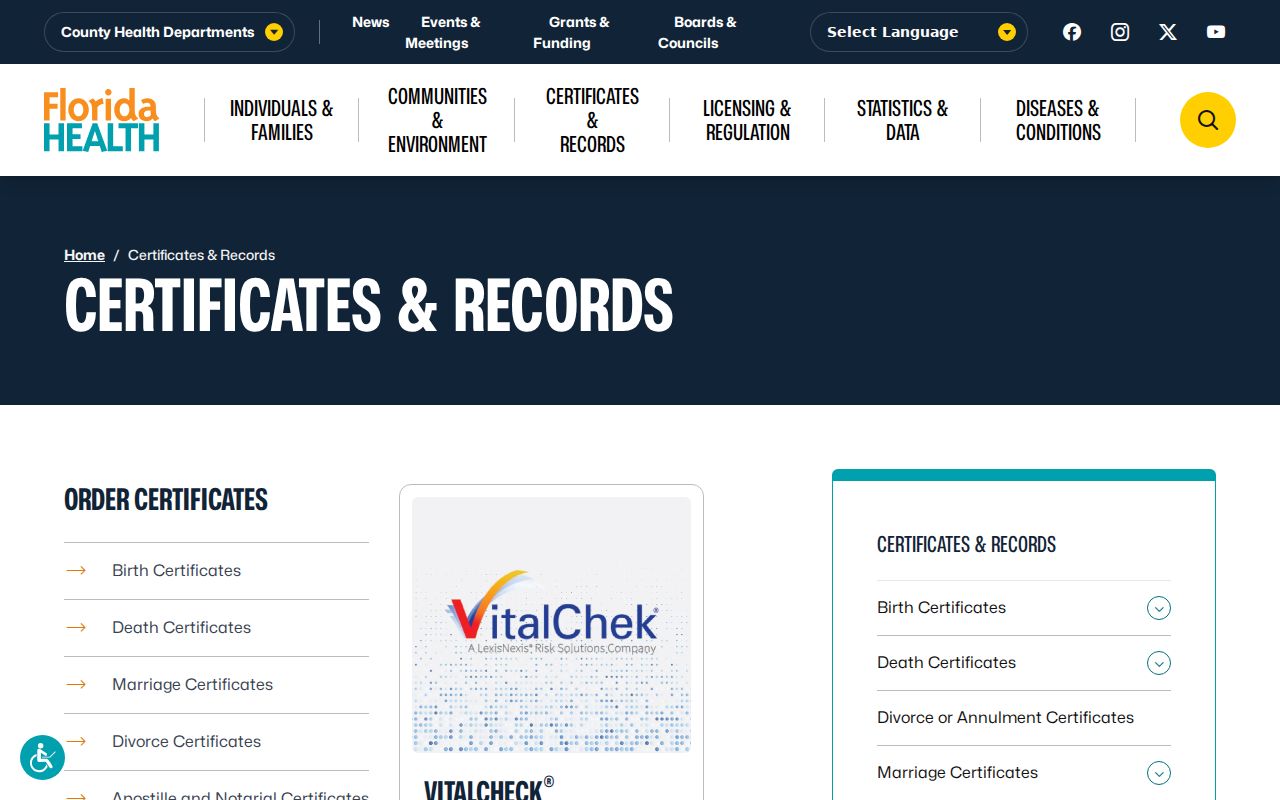
The state gateway directs researchers to birth, death, marriage, and dissolution applications. Certified certificates are different from a public index or docket.
Florida birth certificates less than 125 years old are confidential under chapter 382. Limited birth records exist for 1850 through 1917, while systematic state holdings begin in 1917. The official birth-certificate page sets out eligibility, identification, and order routes.
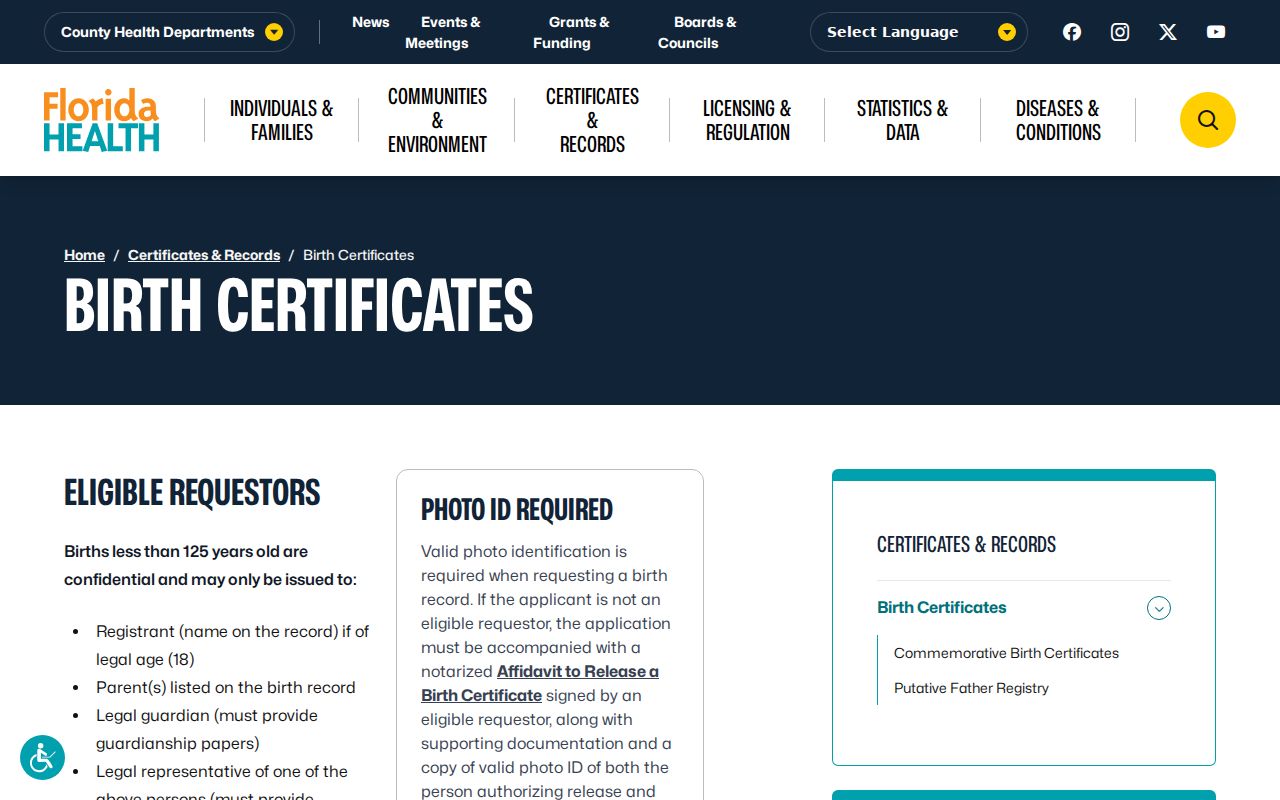
Use a certificate only when the requester qualifies. For deaths, a certification without cause is public to adults, while cause of death remains confidential for 50 years except to eligible people. Marriage and dissolution certifications are generally public; the Clerk holds earlier local marriage records and fuller divorce case files.
Respect Duval County Previous Residents
A deed identifies recorded ownership, not everyone who lived at an address. A directory lists people chosen or reached by its publisher. A census records those enumerated on its date. Permits identify responsible parties, and maps identify buildings. Keep those claims distinct, cite the year, and avoid turning a historical clue into a claim about a living person.
Florida’s Address Confidentiality Program and protected-address exemptions exist for people at risk. Redactions and absent web records must not be defeated through speculation. Previous residents research is strongest when used for family history, estate work, architectural history, and an accurate account of a place.
Lawful use. Research past residents for a legitimate personal purpose. Never use address history to locate, stalk, harass, or harm anyone.